Which countries are represented by these flags? For the answers, see at the end of the eNews.

|

|

|

|

|
| 1 | 2 | 3 | 4 | 5 |
|---|

Which countries are represented by these flags? For the answers, see at the end of the eNews.
|
|
|
|
|
|
| 1 | 2 | 3 | 4 | 5 |
|---|
We’ve all heard horror stories about the deadly Australian funnel-web spiders. A new report in the Lancet shows that deaths from spider bites are extremely rare. Only 26 deaths from spiders have been recorded in Australia in the past century. In comparison, there were 1,183 motor vehicle deaths in 2001 in Australia.
Funnel webs are only found in eastern Australia and there are at least 40 species. They are medium to large spiders, varying from 1-5 cm body length. They like to burrow in moist, cool, sheltered habitats – under rocks, in and under rotting logs, crevices, rot and borer holes in rough-barked trees. In gardens, they prefer rockeries and dense shrubberies, and are rarely found in more open situations like lawns.
Need help? Want a travelling buddy or advice about a place or country – want to share something with us – why not visit our Mutual Aid section of the Website: Mutual Aid
If you enjoy writing, enjoy travelling, why not write for the free monthly Globetrotters eNewsletter! The Beetle would love to hear from you: your travel stories, anecdotes, jokes, questions, hints and tips, or your hometown or somewhere of special interest to you. Over 8,000 people currently subscribe to the Globetrotter e-news.
To see your story in cyber print, e-mail the Beetle with your travel experiences, hints and tips or questions up to 750 words, together with a couple of sentences about yourself and a contact e-mail address to Beetle@globetrotters.co.uk
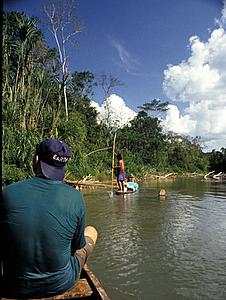 Mistake, mistake, mistake – How could I have made such a stupid
mistake. At our late lunch stop I had changed from boots to
sandals, strong sandals, the problem was not with the footwear but
with my brain which seemed to have gone into non thinking mode as
the day started to turn to twilight. We had been walking fast,
through thick rain forest and crossing and re-crossing rivers or
maybe even the same river. The last few Kilometres of the twenty
seven from our jump into the jungle to the 'Yawanawa'
village, our guides had decided to make what was a two day trek
into one. Why? I have no idea, unless it was too see how we would
make out. My legs felt like lead pillars as I walked in the river
my sandals acting like buckets holding my down feet, like walking
in treacle, my heart pounded loudly with each stride as I tried to
keep up with 'Yawanawa' Indian ahead, who was starting to
disappear in the dusk. The tribe had warned us that the rain forest
was very dangerous at night and they would always be back in the
village by nightfall! Just as I thought I could go no further and
dusk started to turn to darkness, I saw a figure on the shore about
a hundred metres away waving me on. I staggered up to Adam Baines,
for that's who it was, as he said “Well done Tony we have
made it” and we shook hands. Months of politicking in the
urban jungle, then many adventures on the way to our final
destination, the 'Yawanawa' village of Novo Esperanca – At
last we had arrived or nearly, the last hurdle or just about the
last straw, was about seventy steps cut in to the steep river bank
leading up to the village.
Mistake, mistake, mistake – How could I have made such a stupid
mistake. At our late lunch stop I had changed from boots to
sandals, strong sandals, the problem was not with the footwear but
with my brain which seemed to have gone into non thinking mode as
the day started to turn to twilight. We had been walking fast,
through thick rain forest and crossing and re-crossing rivers or
maybe even the same river. The last few Kilometres of the twenty
seven from our jump into the jungle to the 'Yawanawa'
village, our guides had decided to make what was a two day trek
into one. Why? I have no idea, unless it was too see how we would
make out. My legs felt like lead pillars as I walked in the river
my sandals acting like buckets holding my down feet, like walking
in treacle, my heart pounded loudly with each stride as I tried to
keep up with 'Yawanawa' Indian ahead, who was starting to
disappear in the dusk. The tribe had warned us that the rain forest
was very dangerous at night and they would always be back in the
village by nightfall! Just as I thought I could go no further and
dusk started to turn to darkness, I saw a figure on the shore about
a hundred metres away waving me on. I staggered up to Adam Baines,
for that's who it was, as he said “Well done Tony we have
made it” and we shook hands. Months of politicking in the
urban jungle, then many adventures on the way to our final
destination, the 'Yawanawa' village of Novo Esperanca – At
last we had arrived or nearly, the last hurdle or just about the
last straw, was about seventy steps cut in to the steep river bank
leading up to the village.
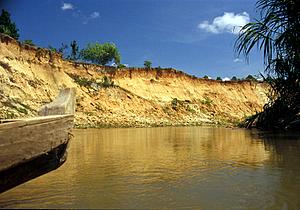 The 'Yawanawa' were early risers, the queue for the
bathroom or in this case the river started at 0415 hours for the
women and then the men from about 0445 hours. Breakfast consisted
of something from the day before, usually highly salted and
difficult to keep down as the sun started to kiss the village roofs
of the 'Yawanawa'.
The 'Yawanawa' were early risers, the queue for the
bathroom or in this case the river started at 0415 hours for the
women and then the men from about 0445 hours. Breakfast consisted
of something from the day before, usually highly salted and
difficult to keep down as the sun started to kiss the village roofs
of the 'Yawanawa'.
Adam and I stayed in the village main
hut, a sort of Pub with no beer or village hall, were the tribe met
either to eat with the chief or discus tribal policies or problems.
This hut had one large interior room with a double bed and a
hammock, I had the hammock after a discussion that I'm not sure
if I won or lost!? There was also a kitchen, or should I say a
small room that contained a medium size gas bottled refrigerator,
used if any medicine had been air dropped to the tribe and needed
to be kept cold and a large jug of water with a tin bowl.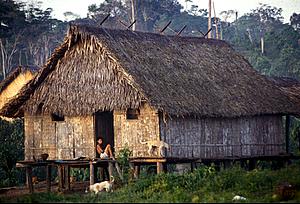 We had a
special treat one night, when the chief switched the fridge on for
a couple of hours and we had a mug of cold water that tasted as
good as any cold beer I have ever tasted.
We had a
special treat one night, when the chief switched the fridge on for
a couple of hours and we had a mug of cold water that tasted as
good as any cold beer I have ever tasted.
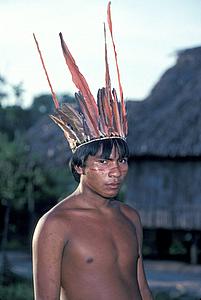 These Indigenous people had five different ways of sustaining
themselves,' in the depth of this green paradise.
These Indigenous people had five different ways of sustaining
themselves,' in the depth of this green paradise.
The hunters split the area around the village into seven parts and one part was never hunted on for seven years. They hunted and ate, monkeys, deer, wild pig, various birds and some things I did not want to know the name of. Fruit and fish were also part of their main diet. These people were just about to experiment with having one field for various vegetables.
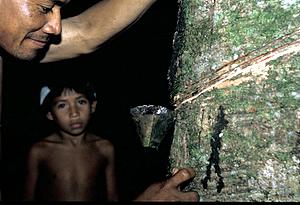 The two ways they made some money was with 'Aveda', a
Canadian firm that bought Uruku off the 'Yawanawa' for the
making of their expensive and famous make up, sold in top shops
like 'Harvey Nichols' both here, France and in North
America. The second way was with tapping the rubber and making it
into a sort of vegetable leather used in bags of all types and also
sold in quality shops in the worlds fashionable capitols.
The two ways they made some money was with 'Aveda', a
Canadian firm that bought Uruku off the 'Yawanawa' for the
making of their expensive and famous make up, sold in top shops
like 'Harvey Nichols' both here, France and in North
America. The second way was with tapping the rubber and making it
into a sort of vegetable leather used in bags of all types and also
sold in quality shops in the worlds fashionable capitols.
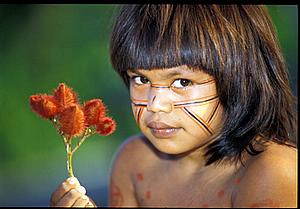 The children had half a day of school and half a day of learning
how to work like their parents, in whatever was their speciality.
The best hunters or fisherman got the best and most desirable woman
as wives. I asked why no one seemed to wear glasses or have bad
hearing? – The answer was simple nobody would marry anyone with
those problems and therefore they were bred out – Survival of the
fittest! Adam's words echoed round my brain, “Lucky you
were born in London Tony”.
The children had half a day of school and half a day of learning
how to work like their parents, in whatever was their speciality.
The best hunters or fisherman got the best and most desirable woman
as wives. I asked why no one seemed to wear glasses or have bad
hearing? – The answer was simple nobody would marry anyone with
those problems and therefore they were bred out – Survival of the
fittest! Adam's words echoed round my brain, “Lucky you
were born in London Tony”.
The money the village made enabled them to have huts made out of
planks but in the same traditional design but better fitting than
the log version.
The tribe lived by some simple rules of the live and let live sort. Laziness was a major sin because it let down a people that had to pull together to survive. Daime was taken once every six weeks, the drug that keeps your head in order, or tidies the files of your mind. The last execution had been fifty years ago and everyone in the tribe had to watch over the age of twelve. The idea being, that when the 'Yawanawa' voted the death sentence, the tribe would know the horror of execution and think carefully before voting for death.
These people gathered on the large veranda of the main house in the evening to eat with the chief, play cards on the only table in the village, with a solitary candle lighting the game. Saturday night would be dance night and they would dance until dawn of the next day. A ghetto blaster run by a car battery, (that had been charged by a solar panel), in one of the huts again lit by one candle, would explode sound into the night frightening off any sort of animal, reptile or even insect far away from the village.
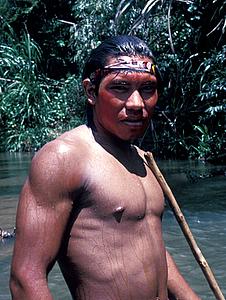 Antonio looked after the canoes and water transport; the tribe
would have its own specialists just as we do in our world. The
Chief himself would deal with the outside world business. The
Marriage with outsiders was not encouraged, The 'Yawanawa'
did not want Aids to in filter the village and also when a non
Indian married one of their girls, they tended to take the bride
out of the tribal area to live.
Antonio looked after the canoes and water transport; the tribe
would have its own specialists just as we do in our world. The
Chief himself would deal with the outside world business. The
Marriage with outsiders was not encouraged, The 'Yawanawa'
did not want Aids to in filter the village and also when a non
Indian married one of their girls, they tended to take the bride
out of the tribal area to live.
As the time came to leave this green paradise, I thought had it been worth all the problems in the urban jungle, difficulties of permissions, of hopes being raised and dashed and then raised again. The answer of course was a big yes. Staying with 'Yawanawa' even though for a short time taught me so much not just about the tribe but about myself as well. Everything is possible, with determination, tenacity, time and a belief in yourself, even when others say that your idea is impossibility.
The villagers of Ngarambe, bordering the Selous game reserve in Tanzanian had been allowed to sell hunting licences and shoot animals for meat so they would no wild animals would not destroy crops or menace the villagers. The area is rich in wildlife of all types – elephants, lions, giraffes, buffaloes and more. The government has said that the community can no longer hunt on this land or sell hunting licences to residents – instead a five-year hunting licence has been sold to a private company. According to BBC news, selling hunting permits is big business – trophy fees in the 2004 season ranged cost $4,000 for an elephant, $2,000 for a lion to $600 for a buffalo.
I am writing a book about a little known but stunning town in Australia called Airlie Beach. I am desperately seeking globetrotters who have visited this region. I am seeking submissions from them based on their time and experiences in the region.
Did Airlie Beach make an impact on your life? It’s the kind of place that is, ‘Once seen, never forgotten.’ I am looking for submissions from people, of all walks of life, on their favourite Airlie Beach experience. Everybody who has been there has one.
As a long time local, I have countless priceless memories, and nobodies amazing memories should be forgotten. Whether it is a funny anecdote, a poem you were inspired to write, a crazy story you heard, a picture of paradise you just can’t forget.
I am publishing a book and will consider: stories, poems, e-mails, snatches of conversation, diary entries, day in the life of, family history, dreams, artwork, photos, drawings etc.
Please contact me on: airliebeachkatie@yahoo.com.au
Last December, the Beetle visited Indonesia. Apart from diving I took a trip to Java from Sulawesi and saw the Borobodur Temple (amongst other things). I stayed a few days in Yogyakarta, a name I shall forever have problems pronouncing and hired a car and driver for US 30 for the day which seemed a pretty efficient way of getting around. Much to the initial annoyance of my driver, we gave lifts to anyone (especially older people) carrying huge bundles and had the freedom to stop wherever I fancied and see out of the way things, and some really were out of the way! Mr Azim, my very patient driver looked after me well, as well as driving like he was trying to break the world land speed record and he made Yogyakarta to the Borobodur in just 40 minutes! Using public transport, it is possible to go by bus or minibus from Yogyakarta to the town of Muntilan, change at the terminal here to another bus for Borobudur. Note that the bus station at Borobudur is 1km away from the temple though it is possible to walk. Alternatively, you can go on one of many guided tours on mini buses to Yogyakarta.
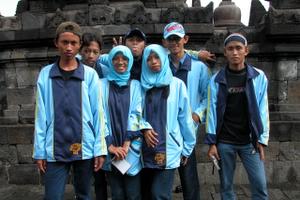
It seemed to be the time of year when schools make their annual school trip outings. There must have been several hundred school children, lounging around, larking about, and taking lots and lots of photos! I found out, by talking with many of the groups that they came mainly from Sumatra and other parts of Java and they were absolutely delightful, as curious about me as I was about them. I got many tips on places to go on my travels and invites to family homes, which was very kind.
This was just one day after the horrific tsunami and there was a muted respect and appreciation for the events that were just starting to unfold, but at the same time, it was a holiday and the school children were having a whale of a time.
The Beetle was pretty much the only non Indonesian visitor on that day and the school children's main task seem to be to detract me from seeing the Borobodur at all, but I didn't mind. It was a lot of fun lining up, arms round the girls' shoulders, smiling broadly for the multitude of cameras that were bought out, just one more, just one more they'd say. And the boys, shyly jostling to see who could stand closest and arms held just above my shoulders, thinking I would not see them or feel them as long as they were not resting on me. They were funny adolescent youngsters. And then there was the name and signature signing in their little notebooks. I thought the whole thing was most odd, but a wonderful way to meet Indonesian people and my entire 4 hours spent there consisted of photo posing, though I got my own back and asked other people to pose for me, notebook signing and having simple English conversations. It was a lot of fun, though I kind of wished I'd had a little more of a chance to see a bit more of the Borobodur!
Ok, about the Borobodur: It is thought to have been built between
the end of the seventh and beginning of the eighth century A.D. For
about a century and a half it was the spiritual centre of Buddhism
in Java and then it was lost until its rediscovery in the
eighteenth century. The temples are set in beautifully manicured
gardens and are said to be composed of 55,000 square meters of
lava-rock is erected on a hill in the form of a stepped-pyramid of
six rectangular storeys, three circular terraces and a central
stupa forming the summit. The whole structure is in the form of a
lotus, the sacred flower of Buddha. For each direction there are
ninety-two Dhyani Buddha statues and 1,460 relief scenes. The
lowest level has 160 reliefs depicting cause and effect; the middle
level contains various stories of the Buddha's life from the
Jataka Tales; the highest level has no reliefs or decorations
whatsoever but has a balcony, square in shape with round walls: a
circle without beginning or end. Here is the place of the
ninety-two Vajrasattvas or Dhyani Buddhas tucked into small stupas.
Each of these statues has a mudra (hand gesture) indicating one of
the five directions: east, with the mudra of calling the earth to
witness; south, with the hand position of blessing; west, with the
gesture of meditation; north, the mudra of fearlessness; and the
centre with the gesture of teaching.
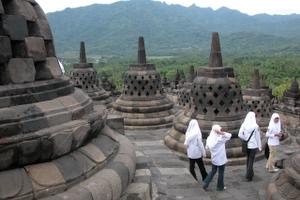
You are supposed to wander around the galleries and terraces always turning to the left and keeping the main structure to the right but I noticed that none of the school children observed this tradition. In total, Borobodur represents the ten levels of a Bodhisattva's life which he or she must develop to become a Buddha or an awakened one.
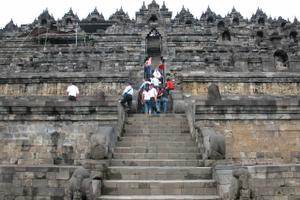 Early morning is the best time to visit Javanese temples, Borobudur
included. The gate opens at 6 am, around sunrise. The view of the
surrounding volcanoes and the Bukit Menoreh range to the south is
clearest at dawn, although morning mists sometimes obscure the view
until 8 am. Visitors must walk 500 meters to the base of the hill
then climb a series of steps to reach the temple foot. To see all
the reliefs one must walk more than 2 km (1.25 mile) around the four
galleries and climb several flights of steps. The minimum amount of
time needed at the Site is 1.5 hours.
Early morning is the best time to visit Javanese temples, Borobudur
included. The gate opens at 6 am, around sunrise. The view of the
surrounding volcanoes and the Bukit Menoreh range to the south is
clearest at dawn, although morning mists sometimes obscure the view
until 8 am. Visitors must walk 500 meters to the base of the hill
then climb a series of steps to reach the temple foot. To see all
the reliefs one must walk more than 2 km (1.25 mile) around the four
galleries and climb several flights of steps. The minimum amount of
time needed at the Site is 1.5 hours.
All in all, it was a highly enjoyable day out and I thoroughly recommend it.
A review in the medical Lancet found the commonest diseases linked to air travel have been spread via contaminated food rather than from the cabin’s recycled air. The US researchers found a total of 41 in-flight outbreaks of food poisoning resulting in 11 deaths had been documented between 1947 and 1999. Salmonella was the most commonly reported infection spread by a commercial airline, with 15 recorded outbreaks between 1947 and 1999, affecting nearly 4,000 passengers and killing seven. The US authors stressed that no food- or water-borne outbreaks had been reported in the past five years probably because of greater use of pre-packaged frozen meals, and improved food handling and inspection.
When: Saturday 18th June, 10.30am-4.00pm
Where: The Newsroom, The Guardian
60 Farringdon Road, London EC1R 3GA
Cost: £85.00
A day of two intensive workshops:
Travel Writing – How to do it and how not to with Dea Birkett, the Guardian’s Travelling with Kids columnist and author of Serpent in Paradise and Off the Beaten Track
Fact, Fiction and Creating a Traveller’s Tale with Rory Maclean, author of Falling for Icarus and Stalin’s Nose
The workshops are followed by practical writing sessions. Participants should bring pen and paper – they will be expected to write! The emphasis is – whether you are a beginner or already have some writing experience – on developing skills which can be applied to both articles and books. Our aim is that, by the end of the day, each of you will have the tools to produce a publishable piece of travel writing.
For further details and application form contact: travelworkshops@deabirkett.com
For further information: