Need to convert currency?
Take a look at The Globetrotters Currency Converter — get the exchange rates for 164 currencies The Globetrotters Currency Cheat Sheet — create and print a currency converter table for your next trip.

Need to convert currency?
Take a look at The Globetrotters Currency Converter — get the exchange rates for 164 currencies The Globetrotters Currency Cheat Sheet — create and print a currency converter table for your next trip.
The next Texas Globetrotters meeting will take place on Saturday March 13th when we look forward to a talk from Southwest Airlines.
The location for the March and April 2004 meetings will be changed, (tax season), so watch your e-mail for the updates.
For more information about the Texas Branch: please contact texas@globetrotters.co.uk or register for email updates at our website (click here) or call Christina at 830-620-5482
If anybody would like to enquire about meetings or help Christina, please contact her on: texas@globetrotters.co.uk
Did you know, you can change the format of this e-newsletter? This e-newsletter is available in 5 formats:
1. This format with 2 columns.
2. A single column print friendly version available online, see the link in every e-newsletter (or click here).
3. The text only version, if you’d like your e-newsletter in plain text format, just send a blank email to The Globetrotters Webmaster with “Text+Enews” as the subject
4. Have a link emailed to you pointing to the online version, just send a blank email to The Globetrotters Webmaster with “Link+Enews” as the subject
5. As an RSS News Feed that you can read using you favourite News Aggregator or News Aggregation site such as newsisfree.com. You can download the RSS file here
Need help? Want a travelling buddy or advice about a place or country – want to share something with us – why not visit our Mutual Aid section of the Website: Mutual Aid
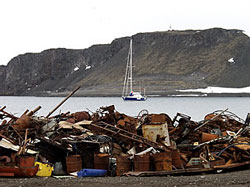
Mission Antarctica set up by Robert Swan after walking to both South & North Pole. Antarctica is a truly unique place, but not as white and pristine as you would first imagine, and Robert was amazed at the rubbish problem.
Antarctica is not owned by anyone, however 44 signatory countries administer the continent. The treaty was set up so that it could be looked after for the future and states that everything brought in to the continent must be taken out, but obviously this was not happening.
 In 1992 Robert was the keynote speaker at the
first Earth Summit in Rio and spoke about the rubbish
problem in Antarctica. With their approval he then set up a
project to do something about it, choosing the Russian Base
of Bellingshausen, as it was one of the worse areas. Also,
it was accessible to visiting ships and had a runway
nearby, allowing both easy access for research into the
removal and aiding the difficult logistics.
In 1992 Robert was the keynote speaker at the
first Earth Summit in Rio and spoke about the rubbish
problem in Antarctica. With their approval he then set up a
project to do something about it, choosing the Russian Base
of Bellingshausen, as it was one of the worse areas. Also,
it was accessible to visiting ships and had a runway
nearby, allowing both easy access for research into the
removal and aiding the difficult logistics.
For a number of years a team of Russian volunteers cut, compacted and moved the scrap onto the beach, stockpiling it to ease the removal later.
During December & January 2001/2002 the Ship “Anne Boye” was chartered and sailed to King George island to remove the scrap. A small team of 5 from the UK, together with the Russian volunteers then managed to move 1,000 tons of scrap from the beach onto the ship, all within 3 weeks.
The site was then levelled by JCB and within that week, the penguins and seals were back on the beach, oblivious to its former history. The waste was then taken to Uruguay for recycling, with the Dangerous waste like Asbestos, fuels and oils, taken to the UK for specialist disposal.
The Yacht “2041” (so named as this is the renewal date of the Antarctic Treaty) played an important role in the operation, as the main aim of the project was worldwide education.
For the first time ever, crew would be flown into the
Antarctic to join the yacht for 8-10 day voyages,
experiencing firsthand the cleanup, together with the
awesome beauty in areas, as yet, untouched or visited by
man.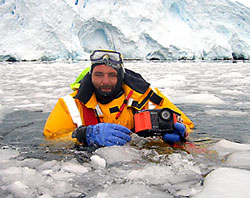
Young people and teachers from 19 different countries sailed onboard Voyages 1 and 2. The aim was to get young people interested now, in preserving Antarctica, which would mean that in their later years when they were working and in possible leadership roles, they would remember this and take positive action to look after the Continent.
Voyage 3 allowed Robert, together with the sponsors, to observe firsthand the cleanup in operation. Voyage 4 was especially for young underprivileged South Africans. They had never even seen the sea before, let alone ice, when they visited the Continent. The final voyage sailed much deeper into the southern peninsular regions, observing how other bases are dealing with their waste. New territories were explored, before returning to S. America ahead of the winter, now closing in. The yacht had now sailed over 4,000M during our 3-Month Antarctic Expedition.
After resupplying in Argentina, the yacht sailed 1,400M to South Georgia, for a two week Expedition to see how the wildlife was coping with the waste left in the numerous abandoned Whaling Stations.
From the near extinction of the seals during the whaling era, they have made a spectacular recovery, and now they rule the very stations that nearly pushed them to the brink of extinction on South Georgia. There are now estimated to be over 1.5 million Fur seals resident on the Island, as well as thousands of Elephant Seals.
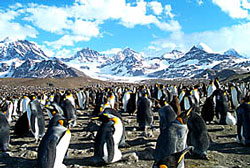 South Georgia is truly one of the world’s
most spectacular wildlife habitats. This is mostly due to
its desolation and the fact that man finds it so very hard
to reach it – even in this day and age.
South Georgia is truly one of the world’s
most spectacular wildlife habitats. This is mostly due to
its desolation and the fact that man finds it so very hard
to reach it – even in this day and age.
King penguins gather to breed in massive numbers, due to its year round access to the sea. On this beach alone there were estimated to be over Half a Million penguins!
On arrival in Cape Town, after a round trip of over 12,000M, the yacht was lifted out the water to be transported overland to Johannesburg, for The World Summit on Sustainable Development, where Robert addressed the United Nations on the success of the project in Antarctica. The yacht become a “floating petition” containing the names of thousands of young people who have pledged their support to the project on preserving & managing Antarctica
During all the Expeditions the crew filmed 25 hours of DV footage, using high quality digital video, together with over 5,000 digital images and 5,000 film images on Transparency. The images were complied, using the onboard video edit suite, onto CD’s for the Participants, to take back to their respective countries to show how the project had succeeded in the waste removal.
Andrew Dare is now conducting multimedia presentations, which explains the whole project from it start in Africa, the cleanup in Antarctica & the return to Africa, via South Georgia.
If you would like further details of this amazing expedition and project or to obtain images, please contact the Yacht Captain, Andrew Dare, e-mail: andydare@bigfoot.com
The World’s Newest Countries
Country (Independence Date)
Source: www.aneki.com
It’s been called Europe’s hottest capital. Slick advertising campaigns have championed the city’s famed nightlife. But there is more to Reykjavik than pubs and clubs. Reykjavik held the prestigious title European City of Culture in the year 2000, a welcome recognition of the energetic and colourful cultural life of Reykjavik.
Reykjavik has the best of both worlds: the qualities of a modern, forward-looking society are complemented by a close connection to the beautiful and unspoilt nature in the city’s vicinity. The world’s northernmost capital is framed by the majestic Mt. Esja, which keeps a watchful eye on the city, and the blue waters of Faxafloi Bay. On a sunny day, the mystical Snaefellsjokull glacier appears crystal-like and baby blue on the western horizon, as the mountainous moonscapes spread to the southeast.
Reykjavik is a great place to visit, whether for a restful relaxation, a spot of unbridled fun or generally to recharge one’s batteries: energy, safety, health and wellness – Reykjavik is indeed Europe’s hottest capital.
Reykjavik is spread across a peninsula whit a panoramic view of the mountains and the Atlantic Ocean on almost all sides. In the summer, you can sit by the harbour at midnight and watch the sun dip slightly below the horizon before it makes its way up again.
The population of the city is about 170,000 when you include the outlying areas and smaller boroughs surrounding the capital. One gets a general feeling of cosmopolitan sophistication built on rock solid foundations.
Ása Kolka Haraldsdóttir works for the Reykjavik tourist board and can be contacted on: asakolka@visitreykjavik.is
Meeting news from our branches around the world.
LAB is running a working and Volunteering in Latin America workshop in London on Saturday 21st February from 10.30am to 5.30pm. From coffee brigades and tree planting to literacy teaching and human rights work, the day will explore the possibilities for being something other than a tourist in Latin America: practical advice and information.
On 13th March 2004, there will be a workshop in London on Tourism in Latin America: what is the social impact of the growth in tourism on Latin America and the Caribbean? A thought provoking day will examine the politics of travel and is aimed at first time travellers to the region as well as veterans.
For more information, see ww.lab.org or contact them on: 020 7430 0542.
Find out what happened at previous meetings in London and about future events
Our first speaker was Paul Goldstein whose talk was entitled “Africa: An adventurous wilderness”. Paul has led many tours into sub Saharan Africa for adventure tour operators over the last few years. We started with shots of Victoria Falls and White water rafting, followed by bathing in a Kenyan mud spring! Paul’s passion is for the wildlife of Africa and we saw some wonderful pictures of lion, leopard, cheetahs and jackals. But the stars of the show for the globies audience were the mountain gorillas. Paul finished up in India with a great shot of a lion taking it easy in the middle of the road.
After the break John Pilkington gave an intriguing talk on his journey up the Mekong river to its source in Tibet. We started off in the markets of Saigon, not a place for vegetarians! John followed the river’s course but not always by travelling on it, he also used local trucks that served as busses. As he headed north into these Buddhist lands we saw Buddhist architecture and playful orange clad monks who thought nothing of playing with a mountain gun left over from a previous war. John took an unusual route over the border into China, he hitched a ride on a Chinese cargo boat delivering noodles and Red Bull! When the Mekong was no longer navigable John took to jeeps and finally onto horseback to become the first Britain to reach the source of the Mekong. (Find out more about John at http://www.pilk.net/lecture.mekong.html)
Our first meeting of 2004 was a series of 4 mini talks given by Globetrotters members. Many thanks to all those who took part, some at very short notice who made it a very enjoyable afternoon.
Our first speaker was London organiser Dick Curtis whose talk covered part of his “Gap year” from teaching. Dick slides took us through India, beginning as most Indian journeys do in the capital Delhi from where he took a train to Kashmir, all very exotic, especially to someone who had not ventured beyond Europe before. Dick’s wonderful photos showed us houseboats, temples and the very photogenic people. Dick met up with some other travellers and with them trekked to Ladakh taking in some beautiful mountain scenery and travelling from Hindu India to Buddhist Ladakh.
Our second speaker was club Membership Secretary Kevin Brackley, who took us to a now virtually impossible to reach destination, Saudi Arabia. His journey started in conservative Riyadh, with its fortress and modern Faisal Tower, then north to Sakaka where he showed us the 6000 year old standing stones in the desert. His trip then followed the old Hejaz Railway through the desert to Medina. We saw beautiful red desert colours, including slides of rocks carved by wind and sand and the spectacular Nabatean city of Maidan Saleh. At Al-Ula we saw old locomotives from the railway abandoned in the desert, before arriving via Medina at Globe Square in cosmopolitan Jeddah on the Red sea.
After the break Martin Wright showed us a glimpse of his marathon cycle ride to Australia. Martin illustrated his trip with great photos and narrative, particularly of some of his ailments along the way! He showed us eastern Turkey, before crossing into Iran, the photos of the tiled mosques at Esfahan were superb. Martin couldn’t get a visa for Pakistan so had to back track before ending up in Nepal and then via some hard uphill cycling into Tibet and Lhasa. He continued down through Indochina before crossing to Australia, where the “Pommie on a bike” was made very welcome, especially in places where according to road signs the population was outnumbered by sheep or flies.
Our last speaker was Globetrotters Legacy Coordinator Jeannie Copeland, who showed us a trip she led in Iceland for Ramblers. Starting in Reykjavik with its colourful houses and lake she travelled up the west coast to Akureyri, where some of her group made the boat trip to the Arctic circle island of Grimsey. Husavik on Iceland’s north coast was the chance for the group to try whale watching. Jeannie’s photos showed the group climbing mountains in a tropical for Iceland, twenty degrees, before travelling through rain to Myvatn, with its rock formations such as Dimmuborgir and natural hot spring pools, great after a long days walking.
After the talks, thanks to Nadia and all those who brought food and drink, we enjoyed the annual Globetrotters New Year party.
Chris Bradley — Walking Wadi Hadramaut [Yemen] – a 550 mile solo unsupported trek and first westerner and Rupert Attlee — The Trail to Titicaca – a 7000 mile cycle adventure through S.America
Anthony Lambert — Railways on the Wlldside – travel on a selection of the World’s railways and Jacqui Trotter — Travelling South America – 8 months of overland and independent travel Part II
London meetings are held at The Church of Scotland, Crown Court, behind the Fortune Theatre in Covent Garden at 2.30pm the first Saturday of each month. There is no London meeting in August, but we will be back in September. For more information, you can contact the Globetrotters Info line on +44 (0) 20 8674 6229, or visit the website: www.globetrotters.co.uk