
India has decided to open Srinagar airport in disputed Kashmir to international flights to entice more tourists to the Himalayan region. Kashmir has been involved in a 15 year dispute involving soldiers and Muslim militants who don’t want Indian rule in the region. Estimates say that around 360,000 people visited Kashmir last year, most of the them Indians, up from 191,000 in the previous year, although the figure was small compared with the millions who travelled to the region before the revolt in 1989. Israelis topped the list of foreign tourists visiting the Muslim-majority region last year followed by Chinese.
Category Archives: enewsletter
Wilderness First Aid courses 2005
Wilderness First Aid is different from the Red Cross or urban first aid. Focus is on initial and prolonged care for a patient in the back country. Participants will receive a two year certification with the Wilderness Medicine Institute of NOLS (http://wmi.nols.edu).
WMI of NOLS courses are for folks who recognises the importance of having first aid skills if you spend time in the outdoors. We have climbers, trekkers, paddlers, blueberry-pickers, parents, teachers, outdoor guides, scout leaders, fishermen and hunters – all learning about how to care for an injured or sick friend.
Below is the schedule for the Wilderness Medicine Institute of NOLS courses that Crossing Latitudes is hosting in Europe 2005.
WILDERNESS FIRST AID COURSES & WILDERNESS FIRST RESPONDER RECERTIFICATION COURSES (16-24 hours)
London, The Castle Climbing Centre, UK January 17-18, 2005 Course fee: US $160.00 / GBP 90.00 per person. Course taught in English.
Malmö, Sweden, January 21-23, 2005 Course fee: SEK 2100:- per person. Course taught in Swedish. Start Friday evening. CPR included.
Bozeman, Montana, USA at Lindley Park Center April 30 – May 1st, 2005 Cost: $150.00 per person. Course taught in English.
Göteborg, Sweden, 13-15 of May, 2005 Course fee: SEK 2100:- per person. Course taught in Swedish. Start Friday evening. CPR included.
Stockholm, Sweden 20-22 of May, 2005 Course fee: SEK 2100:- per person. Course taught in Swedish. Start Friday evening. CPR included.
Narvik, Arctic Norway 17-19 of June 2005 Cost: SEK 2500:- per person. Course taught in English & Swedish. This course is part of Crossing Latitudes Sea Kayaking Guide course. The first aid course is open to all.
If you are interested in having a course just for your staff or organization please contact Lena Conlan at: info@crossinglatitudes.com or call our office in the USA +1-406-585-5356 or our office in Sweden +46-70-670 11 53.
For more info, please contact: info@crossinglatitudes.com www.crossinglatitudes.com USA: 1-800-572-8747 / Fax: +1-406-585-5356 Europe: +46-70-670 1153 Sweden: 070-670 1153
Meeting News from New York
New York meetings will resume in February – subject will be TBD.
Please contact me (Laurie) if you’re interesting in speaking or know of someone who is! For details of forthcoming meetings email newyork@globetrotters.co.uk or register for email updates, click here at our website.
New York meetings are held at The Wings Theatre, 154 Christopher Street (btw Greenwich St and Washington St ), to the right of Crunch Fitness, in the Archive on the first Saturday of each month at 4 pm .
On-Line Travel Scam
Be careful of a new online travel scam that involves bargain flights advertised on internet auction sites. The con-men advertise an amazing deal on an auction site, telling potential bidders that they do not need to pay until they have received their tickets. The winning bidder – and, usually, all the other bidders, are contacted under the pretence that the winner has dropped out for their names. The fraudster then buys the tickets from the airline in the names of each ‘winner’, but uses someone else's stolen credit card details. According to an internet fraud agency, these details are readily available and sold for as little as 30p a time. The winner also pays up once they’ve received the tickets. Most airlines are ok about issuing tickets to someone other than the cardholder, so the ‘winners’ receive their tickets, pay the fraudster and look forward to their holiday, sometimes even flying out and enjoying it. When the airline's bank tries to claim the money from the credit cardholder, however, the fraud is uncovered – and the airline will not let the ticket-holder travel.
Have you got a tale to tell?
If you have a travellers tale that your aching to tell. Then why not visit the “Travel Sized Bites” section of the Website and share it with the world. Travel Sized Bites
Sally Visits Sintra and Cabo da Roca
Sally left the UK around two years ago to start a new life in Portugal. She lives in a suburb of Lisbon, close to the sea and is now a TEFL teacher, teaching English to Portuguese children and adults. This is an account of Sintra.
Sintra was poetically described by Lord Byron as “this glorious Eden”. It was declared by UNESCO as a World Heritage Site. It is easy to get to Sintra by train from the Estação do Rossio station, opening onto Praça de Dom Pedro IV, or the Rossio, where frequent connections can be made. The one-way fare from Lisbon to Cascais, Estoril, or Sintra is 1.25€ to 2.50€ ($1.45-$2.90) per person. There is also a bus from Lisbon. You can drive, as Sally did, but it’s a difficult and tortuous road, as she found out!
The original Sintra is not large to visit but it now includes two outlying areas named Estefânia and São Pedro. As the older part sits on granite slope it is best seen on foot or by a horse-drawn carriage. The town is dominated by the two conical chimneys of the Palácio Nacional da Vila that was the summer home of the royal family since the 15th Century. Scattered on the hillside are several historical buildings, including the Palácio da Pena, a 19th Century recreation of different styles admired by Dom Fernando II, the German husband of the young Portuguese Queen Maria II, and this example often regarded as a failed attempt to create his own romantic revival.
The castle stands high on the southeast side of the mountain range whilst overlooking the village are the ruined ramparts of the Castelo dos Mouros, a fort dating from the 8th Century. Within it is an ancient Moorish cistern and the panoramic view from its walls is impressive. There are several churches in the town and the most interesting is the 12th Century Igreja de Santa Maria rebuilt in 1755 after the earthquake. Several private palaces are open to the public amongst which are the Palácio de Seteais, a magnificent 18th Century home built for the fifth Marquês de Marialva, and later converted into a five star Hotel; Casa dos Ribafrias, a 16th Century building once belonging to the Marquês de Pombal; Quinta de Pena Verde, another 16th Century palace; and the Palácio de Monserrate built in the 19th Century by Francis Cook and influenced by the architectural work of Nash. Another interesting place is the Convento dos Capuchos, an unusual hermitage founded in 1560 with tiny dwarf cells cut from the rock. Within the old town there are several museums, Museu de Brinquedo showing only toys from the past and present, the Museu Regional retelling the history of the area with items and artefacts and sometimes also holding art exhibitions, Casa Museu Leal de Câmara devoted the works of the artist, Casa Museu Dorita Castel Branco also devoted to works of the sculptress, Museu de Arte Moderna, Galeria de Arte Municipal de Sintra, Centro International de Escultura, Museu de Arqueologia São Miguel de Odrinhas, Museu Renato L. Garcia, Atelier Museu de Anjos Teixeira and Museu Ferreira de Castro.
Here is Sally’s account of her recent trip to Sintra.
Went up to the Pena Palace in Sintra – this is the one that you often see on the rare bit of publicity for Portugal. It looks that something that the mad King of Bavaria might have built. All different shapes and designs in yellow and various other colours. I drove up the Sintra mountains – not a very nice drive as the road is a cobbled three quarter width one with drops at one side, pot holes and because the weather was atrocious, and the road is heavily wooded, it was a bit like something out of Lord of the Rings in atmosphere. There is now a very unusual bus that takes you up to the palace (thank goodness). It is obviously a vintage one as it has lovely wall lights and wooden seats and makes slightly heavy weather of climbing up the incline.
The palace is pretty much the same – quite a fascinating place as it is exactly like it was when the Royal Family used to stay there in the summers before they left for exile. There is only about four staff looking after all the rooms – very different to visiting a National Trust property in the UK. Unfortunately because the weather was so dire, the views were not visible – when I went last time the views were incredible – but it’s still worth going. In fact when I drive to work in Cacem on Tuesdays and Thursdays I can just see the Palace in certain places on the drive. The whole of the Sintra area is very magical anyway.
Another great place to visit is Cabo da Roca – the
furthest western point of Europe. Always guaranteed
to be a tad breezy and again great views out to sea.
Gives you an idea of how brave those explorers were in the
olden days and why they thought they would fall off the
edge of the world. 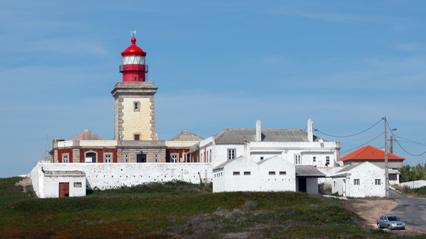
Just nearby is a lovely restaurant/bar in a converted Windmill. It is quite unusual as there are so many different places and corners to sit when the weather is fine. It has the odd waterfall here and there and some ponds with frogs and goldfish. Inside it has a conservatory type front and then two rooms. All beautifully decorated in wood with lots of lamps. Equally nice on a wet and cold day as on a hot and sunny one. It’s one of those places you have to be taken to by a local to know about it. A friend’s mother and father took me years ago and I always wondered where it was and then found it by accident a few months ago and really enjoy taking people to it.
If you would like to contact sally, her e-mail address is: pethybs@hotmail.com
10% tax on US $ in Cuba
If you want to change US dollars in Cuba, you will now have to pay a 10% tax on exchange. The move will affect Cuban citizens who receive money from relatives overseas as well as foreign visitors. The Cuban government said the move was a response to the toughening of the US embargo on Cuba wanted by the Bush administration. Cubans in the US can now only visit the island once every three years and can only send money to their immediate relatives. Cuba made US dollars legal tender a decade ago after the collapse of the Soviet Union forced it to accept foreign capital and legalise some forms of private enterprise. Expect a foreign exchange black market to appear.
Traveller’s Diseases: Decompression Sickness
What is it: decompression sickness, also called the bends, is related to great changes in environmental pressure. It is caused by nitrogen bubbles forming in the bloodstream and tissues of the body. The bubbles occur if you move from deep water towards the surface (where the surrounding pressure is lower) too quickly . It is most usually associated with divers, but can also occur in fliers in a non pressurised cabin when there is a major change in altitude. In the most serious cases decompression sickness can lead to unconsciousness or death.
What are the symptoms: the symptoms generally appear in a relatively short period after completing the dive. Almost 50 per cent of divers develop symptoms within the first hour after the dive, 90 per cent within six hours and 98 per cent within the first 24 hours. In practice this means symptoms that appear more than 24 hours after the dive are probably not decompression sickness. An exception is if the diver has travelled in an aircraft or has been travelling in the mountains. Under these circumstances, low pressure can still trigger decompression sickness more than 24 hours after the last dive. As a result, it is wise not to fly within 24 hours of a deep dive. Mild forms of decompression sickness can resolve themselves without treatment or by breathing 100 per cent oxygen at the site of the accident. The symptoms of decompression sickness vary because the nitrogen bubbles can form in different parts of the body. These can include pain in the joints “bends”. a headache or vertigo, unusual tiredness or fatigue, confusion, a rash, shortness of breath, tingling in the arms or legs, muscular weakness or paralysis, a burning chest pain with a deep breath, a cough or ear or sinus pain.
What happens if I get it: if you suspect decompression sickness, stop the dive, initiate first aid, and summon assistance from a specialist in divers' medicine. Treatment is oxygen on site and during transportation, followed by treatment in a decompression chamber.
How can I avoid decompression sickness?
· Dive within the limits set out in the diving tables.
· Keep your rate of ascent to a maximum 10m/min.
· Don't plan any dives that need a decompression stop in the water.
· Make a three-minute safety stop at a depth of 5m.
· Don't dive more than three times in one day.
· If you plan more than one dive in one day, start by making the deepest dive first.
· If you are diving for several days in a row, have a dive-free day after two to three days.
· Don't do any hard work before or after diving.
· Drink lots of liquid before diving. Lack of fluid due to heat or excess alcohol is dangerous.
· Make sure you are in good physical condition and well rested. Have regular medical checkups.
· Make sure there is an interval of at least 24 hours between diving and travel by air or climbing up mountains. If you have had decompression treatment, the recommended interval before the next dive is at least 48 hours.
Globetrotters Travel Award
Under 30? A member of Globetrotters Club? Interested in a £1,000 travel award?
Know someone who is? We have £1,000 to award each year for five years for the best submitted independent travel plan. Interested?
Then see our legacy page on our Website, where you can apply with your plans for a totally independent travel trip and we'll take a look at it. Get those plans in!!
Explore Paradise with Moon Handbooks Fiji
Avalon Travel Publishing announces the release of the 7th edition of Moon Handbooks Fiji, the original travel guide to the 322-island Fiji archipelago.
Since 1985, Moon Handbooks Fiji has been the leading travel guidebook to Fiji. Author David Stanley began writing about the South Pacific in 1979, and over the years tens of thousands of Pacific travellers have used his guides to Fiji, Tahiti, Tonga, Samoa, and the South Pacific.
Unlike the maps in other guidebooks which contain confusing numbered keys, the 53 maps in Moon Handbooks Fiji are clearly labelled. To allow for detail, three maps of Fiji's capital Suva are included, and two of the gateway city Nadi.
In this 7th edition, all local telephone numbers are increased from six digits to seven, reflecting a recent change by Telecom Fiji. Internet and email addresses are now embedded in the listings for ease of reference.
Rob Kay of FijiGuide.com has this to say about Moon Handbooks Fiji: “Packed with great maps it also has resources such as a comprehensive bibliography, and tips on local etiquette. More importantly, Stanley excels at getting accurate information on hotels, inexpensive restaurants and tourist sites. However there is another reason why his guide is valuable. Stanley does not simply list the properties in alphabetical order and expect the reader to determine what's best. Based on personal visits and feedback from visitors, he will actually offer you an opinion and the straight facts.”
Priced at US$17.95, this book is distributed in the United States by Publishers Group West, in Canada by Publishers Group Canada, in Europe by HI Marketing, and in Australia and New Zealand by Bookwise International. For more information, visit http://www.southpacific.org/fiji.html