
June Meeting News from London by Dan James
Our first speakers this month were Katrina Manson and James Knight, who have just finished writing a new book on Burkino Faso for Brandt travel guides. While in the country Katrina and James were also working for the Reuters news agency and the BBC.
They showed us fascinating images of one of many of the horse festivals popular in the country where riders demonstrate their skills. At these meetings, which are attended by local chiefs as well as as those from neighbouring Mali, musicians sing songs which describe the history of the chiefs of the various clans – there are 60 ethnic groups in Burkino Faso.
While travelling around the country, Katrina and James hired a clapped-out old 4×4, soon discovering that once stalled was impossible to restart. As a result they often had to beseech local people to help them push start it. This led to a few hairy moments, most notably when they got stuck in an area heavily inhabited by lions, and another time when, in search of hippos (Africa’s single largest killer of humans), they drove into a lake and again had to be bailed out by helpful local people. During the experience they also saw how, in spite of supposedly being sacred, crocodiles are frequently hauled out of lakes by their tails, for the benefit of tourists such as themselves.
They also showed us harvest festivals where highly skilled dancers wear elaborate animal costumes and dance for the honour of the village and the chief. Dozens of chickens are sacrificed in order for witchdoctors to ascertain how lucky the village is going to be with the upcoming harvest.
Katrina and James explained how, intriguingly, Burkino Faso has a thriving film industry, with movies frequently shown at large outdoor cinemas.
The country is relatively stable compared to many of its neighbours, but still relies on foreign aid for 40 percent of its income. Its largest industries are cotton and gold, but old-fashioned technology means that these rarely manage to extend beyond cottage industry level. Thanks to government awareness campaigns it also has a very low rate of AIDS/HIV infection at around 2.8 percent, far below the rate of many other African countries.
The country is becoming more popular with tourists, many attracted by ancient, natural formations including peaks and domes in the northern part of the country close to the Sahara desert.
Our second speaker was Patricia Baker, who has also just written a book for Brandt, this time on Iran, a country she first visited in 1971. She continued to go to the country up until the Iran-Iraq war broke out in 1980 but was not able to return until 1993; now usually visiting twice a year.
Patricia showed us images of religious iconography including the beautiful glass and mirror work contained in many mosques, much of it many hundreds of years old. These included many images relating to the prophet Muhammad. She also displayed more modern depictions, including public posters, some referring to spiritual events.
She said the process of getting a visa for Iran can be very long-winded, but once inside the country, visitors are overwhelmed by the friendship, kindness and hospitality of the people. However, she warns those thinking of going to expect to be asked questions along the lines of: “Do you know Manchester? My brother is there.”
She also urged, with more than 20,000 recorded road fatalities every year, against driving in the country.
London meetings are held at The Church of Scotland, Crown Court, behind the Fortune Theatre in Covent Garden at 2.30pm the first Saturday of each month. There is no London meeting in August, but we will be back in September. For more information, you can contact the Globetrotters Info line on +44 (0) 20 8674 6229, or visit the website: www.globetrotters.co.uk
 China's rising thirst for oil has long caused consternation in the geeky circles of the oil industry, as most recognized some time ago that the growing band of Shanghainese abandoning bicycles for BMW's would mean a sharp rise in global petrol demand. With the world now well aware of this dilemma, the oil industry is pondering where it will find sufficient oil to meet China's needs.

 Most journeys into the desert begin in Urumqi, a modern city indistinguishable from any other second tier Chinese city. Though it formed part of the original Silk Road, a journey through the desert was long considered a death sentence, and it wasn't until 1995 that a highway was erected. Though the highway allows access to the amenities of the region's cities to the tiniest desert village, some villages chose to remain closed and the highway was evidently rerouted and the villages excluded from maps to accommodate this. Ironically, those who put great store in recreating ancient methods of traversing the desert (donkey, rickshaw, et al) also rely heavily on the “shamo gonglu” highway.
 There are also plentiful cultural activities along the route, including the remains of the “lost city” of Subashi, well-maintained mosques, and little visited museums – we had to wake the curator from a lunchtime nap to ask him to turn the lights on for us in one.
  In 1993, UNESCO declared the Camino de Santiago a world heritage site. It starts from the boarder of France and works it way west to the city of Santiago de Compostela covering some 750 kilometres. Originally, pilgrims had to navigate their way using the sun, moon, stars, and even the Milky Way. Getting lost was part of the journey. Today, the trail is so clearly marked that losing your way is not really an option. With shiny traffic signs, brass and tile scallop shells, and the distinct yellow arrows you'll always be pointed to Santiago.
 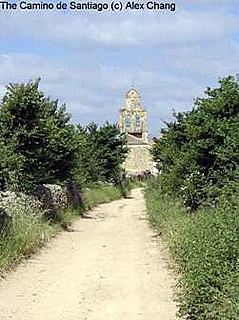 The oldest documentation of the Compostelana, the official certificate of having completed the pilgrimage, was delivered to André le Breton in the Capilla del Rey de Francia and dates back to 1321. Almost 700 years later, you can still request the Compostelana certificate, complete with your name in Latin. To be eligible you must have either walked or ridden a horse for the last 100 kilometres or bicycled the last 200 kilometres. The demand for this document has grown such that there is now a special Pilgrim's Office that will attend to your petition.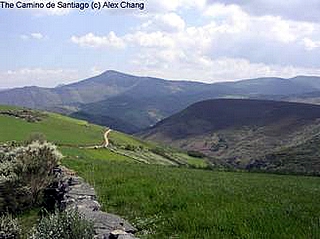
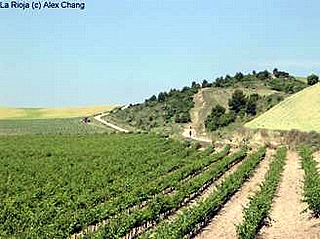
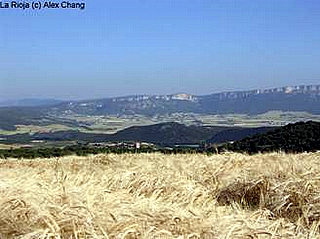
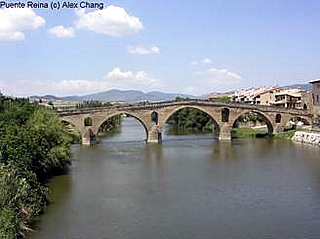 Despite a thousand years, the Camino de Santiago remains and its pilgrims continue to flow into Santiago. The Camino is an unforgettable experience that creates a special bond and camaraderie among all those who have walked it. In a world where things change so quickly, the Camino de Santiago is so refreshing as things really haven't changed so much after all!
 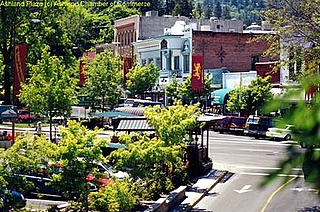 The downtown (all eight blocks) could serve as the set for Our Town. It centres on the block-on-a-side triangular Plaza and adjacent Lithia Park, which becomes more natural as one follows its creek into the mountains. Only one building is over three stories; it and 28 others are on the National Register of Historic Places. The town owns both a fibre optic network and a ski resort at nearby Mt. Ashland. A commission awards a bronze plaque to the “tree of the year.” There never will be a shopping mall in Ashland. McDonalds went broke.
  over sixty B&B's in turn-of-the-century Craftsman and Victorian homes that characterize the town and some twenty hotels and motels, including several in the downtown area.
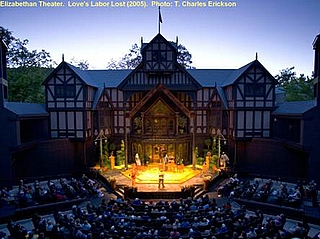
  Venice and Twelfth Night. The town council stipulated boxing matches to cover the expected deficit, hoping Bowmer would not accept such an undignified linkage. Bowmer found the idea in keeping with the bawdiness of Elizabethan theatre and accepted. Ironically, the plays covered the deficit of the boxing. The Festival has continued ever since, with a few years off while Bowmer served in World War II. In 2007, the Festival will present As You Like It, On the Razzle (a variation on The Matchmaker aka Hello Dolly), The Cherry Orchard, Gem of the Ocean, and Tartuffe in the modernistic Bowmer. Three new American plays, Rabbit Hole, Tracy's Tiger, and Distracted will be in the intimate New Theatre. Romeo and Juliet, Taming of the Shrew, and Tempest will be in the half-timbered, outdoor Elizabethan.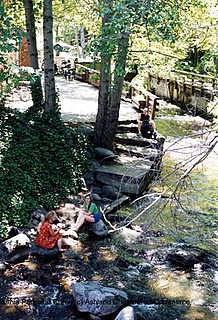
 About the author: David is professor emeritus of Behavioural Science and of Humanities, California State University, and author of over 100 books and articles including Why We Fight: Theories of Human Aggression and Conflict (2005). He has been a Fulbright Scholar in Cyprus and Ukraine, a Malone Scholar in Bahrain and Saudi Arabia, worked in Australia, Singapore, and Morocco, and visited over 100 countries. He is co-founder and treasurer emeritus of Wildlife on Wheels, which provides live wild animal education programs to 100,000 Los Angeles basin children each year. He is married and has one child. Picture was taken of David and his family in the Raffles, Singapore (which is not the place it used to be, unfortunately.)