Since 2001, in Swaziland, teenage girls have had to wear large
woollen tassels as a sign of their chastity. Now news comes that
Swaziland's King Mswati III has ended a five-year sex ban he
imposed on the kingdom's teenage girls a year early and there
is to be a ceremony where all tassels are burned. The sex ban was
allegedly imposed to fight the spread of HIV/Aids.
The king fined himself a cow for breaking the ban by marrying again
– he married a 17-year-old girl as his ninth wife just two months
after imposing the sex-ban in September 2001, sparking
unprecedented protests by Swazi women outside the royal palace.
Swaziland has one of the world's highest HIV infection rates,
at about 40% of the population. Meanwhile, the health ministry has
released new figures which show that 29% of Swazis aged 15-19 are
HIV positive and for pregnant women, the figures were 42%.
British airline bmi plans to launch daily services to Mumbai. Bmi,
which hopes to compete with larger rivals British Airways and
Richard Branson's Virgin Atlantic, starts the four-times-a-week
service from London to Mumbai this Saturday.
Kenya Airways will start direct flights to Istanbul in June 2005,
hoping to serve an increasing number of African traders visiting
Turkey. The twice weekly flights to Istanbul will make Kenya
Airways the only airline from sub-Saharan Africa to fly to Turkey,
the airline said.
Mexico's government is privatising top carriers Mexicana and
Aeromexico, and has recently handed out concessions to low-cost
airlines. A Mexican billionaire called Carlos Slim and broadcaster
Televisa are joining forces in a new low-cost airline to be called
Vuela. Vuela already has a concession to operate and expects to
begin flights in the first half of next year from the international
airport in Toluca, west of Mexico City. Earlier in July 2005,
Brazilian airline Gol said it planned to launch a low-cost carrier
in Mexico. Another new airline, ABC Aerolineas, also plans to begin
service in the low-cost market, which has quickly grown in the
United States and Europe with mixed results.
Yes, it is possible to tour one of the most famous television
centres in the world. The tour lasts up to 2 hours. You'll see
into the studios, visit BBC News, play in the interactive studio
and be shown around by well-informed, entertaining guides.
Please note that Television Centre is a working building so no two
tours are ever the same.
Pre-booking is essential. Regular tours Monday to Saturday. They
are open to anyone over 9 years old.
Prices – Adult £8.95 Concession £7.95
Students £6.50
Children (over 9 years) – £6.50
Family ticket (2 adults & 2 children or 1 adult & 3
children) £25.00
Group rates available
Prices valid until 31st March 2006
To book tickets:
Please call: 0870 603 0304
Outside the UK call: +44 28 9053 5904
Textphone for hearing-impaired callers: 0870 903 0304
If you have any special interests or requirements please state them
at the time of booking.
The Inka Porter Project has issued a new set of environmental
guidelines for trekkers on the Inca Trail in Peru and other Andean
hiking circuits. Visit their website at www.peruweb.org/porters for the full
guidelines, which give advice on dealing with rubbish, washing with
biodegradable soap, using refillable water bottles, toilet
etiquette while trekking, and how best to respect flora and fauna.
Reunion Kingston London Sunday 11th Sept 2005 for any member of
Globetrotters who travelled overland to India or on the rail tours
organised by Butterfields. Please e-mail butterfieldashley@yahoo.co.uk
In a speech accusing the South African government of failing to
make crime a priority issue, a South African politician claims that
the murder rate in South Africa is roughly the same as the death
rate from terror attacks on civilians in Iraq. “The murder
rate in South Africa, at about 43 murders per 100 000 people, is
roughly the same as the death rate from terror attacks on civilians
in Iraq” were the figures quoted. “So, despite the
government's claims that crime is 'stabilising', South
Africans are still living in what amounts to a state of civil war
between criminals and law-abiding residents.
According to the South African Law Commission, only 6% of violent
crimes reported to police result in a conviction, and 75% do not
even make it to court. South Africa's overcrowded prisons were
described as “universities of crime”. and said they are
not rehabilitating criminals. An alarming recent trend is the rise
in crime involving youths. “Forty-four percent of the children
under 14 who were taken to Durban mortuaries in 2004 had been shot
dead, for example.” Young people are also, increasingly, the
perpetrators of crime. “The number of children convicted of
violent crime jumped by 5% from 2003 to 2004, according to the
National Institution for Crime Prevention and the Reintegration of
Offenders.
Spotted by Webmaster Paul, here's a satellite photo from Google
of the
Lake District.
French President Jacques Chirac has again urged world leaders to
impose a levy on airline tickets to finance extra aid for Africa.
If accepted, the tax would be imposed on tickets of planes leaving
from airports in participating countries.
Chirac, who told the World Economic Forum in January that a tax of
USD$1 per airline ticket could raise USD$10 billion a year to fund
campaigns against diseases in Africa, pressed his case in a letter
he wrote to more than 140 world leaders.
“I offer you to associate yourselves with the establishment of
an international solidarity contribution on plane tickets, aimed,
particularly, at financing the fight against AIDS, tuberculosis and
malaria”.
The Group of Eight industrialized nations have decided to consider
imposing a levy on airline tickets to finance extra aid for Africa,
a proposal which has run into opposition in Europe and the United
States.
Chirac's idea has received support from Germany, but even
though talks so far have centered on a voluntary tax, some other
European governments, including tourist destinations Greece and
Italy, have given the idea an icy reception.
Every September the annual Open House
London event takes place and this year the dates are 17th &
18th September 2005. Over 600 buildings are opening their doors to
everyone and turning the capital into a living architectural
exhibition. And it's absolutely free!
Two former America West pilots have been convicted of operating a
packed passenger plane while drunk and sent to prison on Thursday
by a Florida judge, who called their crime “outrageous and
horrendous.”
Judge David Young sentenced Thomas Cloyd, 47, to five years behind
bars — the maximum term — and Christopher Hughes, 44, to 2-1/2
years in prison for trying to fly from Miami Airport on July 1,
2002, after a night of beer drinking.
The pilots' Airbus A319 aircraft was being towed to the runway
for takeoff to Phoenix with 124 passengers and three flight
attendants aboard when it was ordered back to the terminal. A
security screener had reported that the pilots smelled of alcohol.
They had spent the evening before playing pool and drinking at a
Miami area bar. They left the bar around 5 a.m. after running up a
tab for 14 jumbo glasses of beer — the equivalent of nearly 22
pints (10.5 litres) — and showed up late for the 10:30 a.m.
flight. FAA rules bar pilots from consuming alcohol for eight hours
before a flight.
Unusually high concentrations of jellyfish have appeared along
Spain's Mediterranean coast this summer. The Red Cross said its
lifeguards had treated almost 11,000 people for stings on beaches
so far this season in the north eastern region of Catalonia alone,
twice the number from the same period last year, when the jellyfish
count had already begun to rise. Factors like drought, heat and
over fishing contribute to a rising jellyfish count, according to
the international environmental group Oceana.
France: water-rationing is in place across more than half of
France, with the west particularly affected by drought. A plague of
locusts in the south of France, around Aveyron, has been put down
to the continuing dry, hot weather.
Spain: is suffering its worst drought since records began in
1947, with the east particularly badly hit. Temperatures have risen
to 40C (104F) in parts of Andalusia, in the south. Water is also
being rationed across half the country, including in major tourist
centres.
Portugal: Portugal faces its worst dry spell since the
1940s. Some 97% of the country is suffering a severe or extreme
drought, ministers say. Shortages are particularly acute in the
Algarve region, where the population more than doubles during the
peak tourist season.
Italy: the temperature has topped 35C (95F) in cities
including Milan, Florence and Turin. Several people have died in
northern Italy as a result of the intense heat.
According to the Nepal Tourism Bureau, in the first four months of
this year, covering the peak spring tourist season, Nepal logged
roughly 72,000 tourists, a reduction of 34 percent from the same
period last year. The Tourism Board has also tried to lure back
trekkers, slashing fees by half – to about $5,000 for a team of
seven – for some prime peaks, including Kanchenjunga, which at
8,600 meters, or 28,200 feet, is the world's third-highest
mountain. Government tourism officials have said that Nepal, after
King Gyanendra's emergency proclamation, is safer than ever
before.
The Maoist insurgents, who have been fighting the government since
1996, officially welcome foreign tourists. Well, they would – a
significant part of their income is derived from charges or tolls
extracted from individual tourists, lodges and other
tourism-related industries.
Many foreigners have stayed away from Nepal. Peace Corps activities
were suspended in September because the U.S. government lists the
Maoist rebel group as a terrorist organization so American citizens
are forbidden to contribute funds, goods or services to or for the
benefit of the Maoists, according to the State Department.
Huge parts of the countryside are effectively no man's land,
where the rebels or government troops may be found. On the
Annapurna trail, there are plenty of rebels who try to collect
their taxes from tourists and it is considered dangerous to refuse
the demands of the guerrillas. The Mount Everest trail from Lukla
onward remains untouched by fighting, according to trekking groups
that organize tours to Everest.
Sometimes a tourist hotel is bombed, but it is said that this some
of these attacks are staged because the hotel owner's payments
to the guerrillas have been regarded as unsatisfactory. The latest
incident came on May 20, when a hotel in Pokhara, in the foothills
of the Himalayas and a stop on the Annapurna trail, was attacked
with a homemade bomb, injuring two waiters.
Educational travel conference at York St John College in York, UK
on Saturday 15th October 2005 from 9.30 am to 5.00 pm. Tickets cost
£15 (£10 for students) including lunch and refreshments.
A practical day of advice and guidance to help prepare and support
young travellers on their gap year travels.
Young travellers, educators and parents are
encouraged to attend this one day Educational Travel Conference
& Exhibition which will provide information & options on
how to get the maximum out of travel experiences whilst keeping
safe.
Full programme of experts including former BBC war correspondent
and independent MP, Martin Bell and Deidre Bounds, founder of
Leeds-based i-to-i the UK's largest company specialising in
volunteer travel.
For further information, see:
www.carolinesrainbowfoundation.org
When the first modern humans evolved in Africa, they lived mainly
on meat hunted from animals. Scientists had always thought the
exodus from Africa around 70,000 years ago took place along a
northern route into Europe and Asia. Now, according to a new
genetic study, it seems that early modern humans followed the
beach, possibly lured by a seafood diet. The study believes that
humans quickly reached Australia but took much longer to settle in
Europe. Dr Martin Richards of the University of Leeds, who took
part in the study, says the first humans may have moved south in
search of better fishing grounds when stocks in the Red Sea
dwindled due to climate change. The new research suggests they
moved along the coasts of the Arabian peninsula into India,
Indonesia and Australia about 65,000 years ago. An offshoot later
led to the settlement of the Middle East and Asia about 30 to
40,000 years ago.
Need to convert currency?
Take a look at The
Globetrotters Currency Converter – get the exchange rates for
164 currencies The
Globetrotters Currency Cheat Sheet – create and print a
currency converter table for your next trip.
Potential good news for those wishing to travel to Spain. According
to newspaper ABC, Spain's flag-carrier Iberia will launch a
low-cost airline at the beginning of next year. The new airline may
be called “Mediterranea” and will have its hub in the
Mediterranean city of Barcelona, the paper said. An Iberia
spokeswoman said it was still considering the option of a no-frills
sibling, but nothing had been decided yet. “We still don't
know whether we're going to do it or not,” the spokeswoman
said. “It's something that will be covered in the
strategic plan we'll unveil in September.”

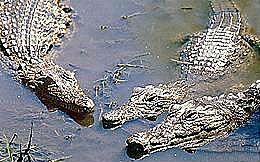 Framed by glowing sunsets and a bountiful
canopy of stars, lies the Kruger National Park. The park, rich in
biodiversity, was established in 1898 and stretches for 350km (approx
140 miles – within the park itself the road network measures in at
about 1300 miles) from the south to north along the Mozambican border
before meeting up with the Zimbabwean border. A paradise for the
wildlife enthusiast with close to 150 mammals to be on the look-out
for, amongst them six cat species, the park also has more than 500
species of birds and over 300 species of trees for the visitor to
identify. With its subtropical climate, the large habitat variety and a
surface area of 19 633km², the park is home to a spectacular
array of fauna and flora and is undoubtedly the world leader in dynamic
environmental management techniques and policies based on experience
gained over more than a century.
Framed by glowing sunsets and a bountiful
canopy of stars, lies the Kruger National Park. The park, rich in
biodiversity, was established in 1898 and stretches for 350km (approx
140 miles – within the park itself the road network measures in at
about 1300 miles) from the south to north along the Mozambican border
before meeting up with the Zimbabwean border. A paradise for the
wildlife enthusiast with close to 150 mammals to be on the look-out
for, amongst them six cat species, the park also has more than 500
species of birds and over 300 species of trees for the visitor to
identify. With its subtropical climate, the large habitat variety and a
surface area of 19 633km², the park is home to a spectacular
array of fauna and flora and is undoubtedly the world leader in dynamic
environmental management techniques and policies based on experience
gained over more than a century. 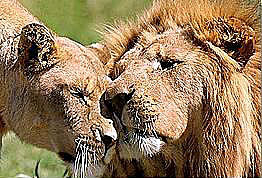 Most
national parks also offer organised night drives or early morning
drives in park vehicles with guides, but they have to stay on the road
and take place at set times, so many people hire a car themselves to
explore the parks on their own. Most parks have rest camps, and
— depending on the park – a range of accommodation,
from camps and huts to bungalows and guest houses. Most accommodation
is equipped with self-catering facilities, although many camps do have
shops, and some have restaurants.
Most
national parks also offer organised night drives or early morning
drives in park vehicles with guides, but they have to stay on the road
and take place at set times, so many people hire a car themselves to
explore the parks on their own. Most parks have rest camps, and
— depending on the park – a range of accommodation,
from camps and huts to bungalows and guest houses. Most accommodation
is equipped with self-catering facilities, although many camps do have
shops, and some have restaurants. 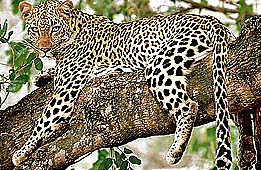 In
the winter, when water is scarce and the plant life dies back, the
animals are easier to spot, especially at water holes and riverbeds.
This is the most popular season, so be prepared to share your safari
with other motorists. The days are warm, but temperatures can drop
close to freezing at night, and units are not heated. Try to avoid
going during the school holidays, particularly in winter, when the park
is packed to capacity.
In
the winter, when water is scarce and the plant life dies back, the
animals are easier to spot, especially at water holes and riverbeds.
This is the most popular season, so be prepared to share your safari
with other motorists. The days are warm, but temperatures can drop
close to freezing at night, and units are not heated. Try to avoid
going during the school holidays, particularly in winter, when the park
is packed to capacity.  The
The