Need to convert currency?
Take a look at The Globetrotters Currency Converter – get the exchange rates for 164 currencies The Globetrotters Currency Cheat Sheet – create and print a currency converter table for your next trip.
Need to convert currency?
Take a look at The Globetrotters Currency Converter – get the exchange rates for 164 currencies The Globetrotters Currency Cheat Sheet – create and print a currency converter table for your next trip.
The Peruvian government is to sue a unit of the Chilean airliner LAN over an in-flight video it showed allegedly depicting Lima as not a very nice place to go. The in-flight video is said to include old images of a man urinating in the street and gutters filled with litter. Peruvian officials say that the material misrepresents the capital Lima. The airline has apologised and withdrawn the film and three of its senior executives have resigned.
The British Foreign & Commonwealth Office advise against all but essential travel to Andizhan in eastern Uzbekistan until further notice. An armed gang attacked a prison and a military unit in Andizhan in eastern Uzbekistan on 13 May 2005, releasing inmates, amongst them political prisoners. Around 2,000 protesters reportedly gathered in Andizhan town square, some occupying the Mayor's office. Government troops are reported to have opened fire on protestors. Local authorities have confirmed that several were killed. Eye-witnesses have put the figure of dead in the hundreds.
Uzbekistan's borders are potential flashpoints and some are mined. There were reports on 14 May of unrest on the border with Kyrgystan. You should avoid all but essential travel to areas bordering Afghanistan, Tajikistan and Kyrgyzstan.
There is a high threat from terrorism in Uzbekistan. Indiscriminate attacks could occur in public places where foreigners may gather including, but not limited to, bars, restaurants, hotels, nightclubs and bazaars. Pay attention to any security announcements by the Uzbek authorities.
On 13 May 2005, a suspected suicide bomber was shot dead outside the Israeli Embassy in Tashkent.
Suicide bombings near the US and Israeli Embassies and at the Uzbek Prosecutor's Office on 30 July 2004 reportedly killed four people and injured at least eight. We advise the local British community to be vigilant and stay in touch with the Embassy.
There have been occasional muggings and petty crime against foreigners, sometimes by off-duty policemen or those pretending to be policemen. Keep valuables out of sight and avoid unlit or remote areas. You should avoid obvious displays of wealth, especially in rural areas. You should avoid walking alone at night. We understand that since September 2004 there have been a series of assaults and murders of young children in Tashkent. The authorities are investigating the disappearance and murder of a number of young children between the ages of 9 and 14, some of whom went missing on their way to or from school. Therefore we would urge all those with children to be extra careful and to take precautions, such as not allowing their children to travel to and from school alone and explaining to children not to engage with strangers.
Artists Against AIDS USA will be in Melbourne 27 November 2005 to support “Rockin the Square” in Federation Square for their second World AIDS Day concert
Once again, we'll be sending our very own “Star Search” finalist (and Melbourne's new favourite crooner), Spencer Day who will be accompanied this year by the multi-talented Shayna Steele who just completed a successful run on Broadway with “Hairspray – The Musical”
In an effort to keep costs down, we are trying to get a jump on air-fares, hotel accommodations plus other events/venues where we might be of service while we are in OZ.
If you could quote us on your current airfare from the US to Melbourne (or thereabouts) and accommodations somewhere in the vicinity of Federation Square, it would be appreciated.
Questions, comments or press kit requests can be directed to Joe in our San Francisco via this email address: joe@a3usa.net
Artists Against AIDS USATeam SOHO www.a3usa.net
Flying into Iran? Iran opened its new international airport, the Imam Khomeini International Airport in Tehran at the end of April 2005, despite warnings from Britain and Canada who fear that the runway may be unsafe. Neither Britain nor Canada said exactly why they were concerned about the safety of the runway. “We are aware of reports that the runway at the new Imam Khomeini International Airport in Tehran may not yet be suitable for use,” the British Foreign Office said in a travel advisory. We are in contact with the Iranian authorities about this. Until the situation has been clarified, we advise British travellers to travel by flights using the existing airport.”
Scientists believe that Maldive Islands were first settled by Aryan immigrants who are thought to have colonised Sri Lanka at the same time, (around 500 BC). Further migration from South India, as well as Sri Lanka, occurred. The latest archaeological findings suggest the islands were inhabited as early as 1500 BC. Around 947 AD, recorded contact with the outside world began with the first Arab travellers. As the population increased, the Maldivian people with their mixed features formed tight-knit island communities. Historical remains dating back to 400 BC show strong evidence that Buddhism was widely practised among the people. Islam came to the Maldives with the Persian and Arab travellers and in 1153 AD Arabian traveller Abul Barakhat Al-Bar Bari is said to have been responsible for the conversion to Islam. In 1558, the Portuguese invaded and captured the Maldives. They ruled the country for 15 years, until Boduthakurufaanu, the national hero recaptured the Maldives from the Portuguese. He ruled the country as Sultan Mohamed Thakurufaanu from 1573 – 1583.
The Maldives became a British Protectorate and a dependency of Ceylon (Sri Lanka) in 1887 and remained so until 26 July 1965 when they gained full independence. The independent Maldives reverted from a Sultanate to a Republic on 11th November 1968 and since then the country has remained a fully independent republic.
The first resort, Kurumba Village was developed in 1972, on an uninhabited island near the capital, Malé. The resort, had accommodation for about 60 guests. The second resort was Bandos, with about 280 beds. The services in the two resorts were quite basic compared to that of others in the region. The food was mainly local and the transportation quite slow. It was also a time when air travel to the Maldives was only available on Air Ceylon which operated a small Avero aircraft. This plane carried only 48 passengers and took two hours to reach Malé from Colombo. Despite this, over a thousand tourists came to the Maldives in 1972. In 2003 the Maldives consists of more than 80 resorts, and over 500,000 visitors from all over the world. Italian visitors account for approximately 25% of all visitors, followed by the UK at 17%, Germany at 14% and Japan at 9% and the average stay is 8.5 nights.
The Maldives hold the record for being the flattest country in the world, with a maximum altitude of only 2.3 metres. Although there have been reports of rising sea levels threatening the islands, the sea level has actually lowered in recent decades. There are said to be 199 inhabited islands and 993 uninhabited islands.
The December tsunami reached the Maldives at approximately 9.20am on 26 December 2004, sending waves up to five metres high over the 1192 islands. The disaster is believed to have caused damage to 69 of the 199 inhabited islands and 14 islands are said to be completely devastated and had to be evacuated. In total, some 20,500 islanders were displaced from their homes and 83 people were killed, including three tourists. A further 25 people are still missing and presumed lost in the disaster.
Even before the disaster, environmentalists were concerned about the risk to the islands from rising sea levels. The most serious damage was to the islands along the east coast of the group, particularly in North Malé Atoll and South Malé Atoll, but the capital, Malé, and the international airport on Hulhule island experienced only minor flooding. The tsunami also caused significant damage in the far south of the Maldives, particularly to Vilufushi in the Thaa Atoll and Kolhufushi in the Meemu Atoll. In the north, Kandholhudhoo island in the Raa Atoll was completely destroyed, displacing 3,000 islanders from their homes. The island has since been abandoned. Cartographers are planning to redraw the maps of the islands due to alterations by the tsunami.
Despite the massive damage to homes, schools, harbour facilities, telephone and electricity suppliers and general infrastructure, the loss of life was thankfully comparatively small, especially when compared with Indonesia, Sri Lanka, India and Thailand. Still, estimates suggest that around 7% of the population has been left homeless by the disaster and the overall cost of damage is estimated at US$470 million, or 62% of the islands' GDP. The government has reported that the impact of the tsunami will set back development in the Maldives by two decades.
Despite this, the emergency relief effort has been extremely successful, though some would say that it has been challenged to the areas most frequented by tourists. As of March, 71 of the 87 resorts in the Maldives were open as normal and tourists could visit Malé and other areas that escaped major damage without problems. However, 16 resorts remain closed as a result of the disaster – for an update on the 16 hotels that are closed, see: www.visitmaldives.com.mv
No prior visa arrangements are required, but some requirements must be fulfilled to obtain a 30 days tourist visa on arrival: a visitor must have a valid travel documents and properly completed embarkation/disembarkation cards which usually provided at during the inward flight. In addition, visitors must also have a return air ticket or at least US$ 50.00 per intended day of stay in Maldives. Any amount of Foreign currency can be brought in without declaring and can be taken out without any restriction. Some items are forbidden to be imported to the country, including firearms and explosives, pornography of any kind, including what would be considered “acceptable erotica” in all western (and most eastern) societies, pork and all products containing pork, narcotic drugs, poisons and hazardous, irritable or industrial chemicals and alcohol. Alcoholic items purchased on the trip will be held in Customs bond for collection upon departure.
The Health Protection Agency say that tourists need more advice about how to protect their health while they are away. They say, while many companies do tell travellers to get health advice about their destination, others do not. But a spokesman for the Association of British Travel Agents (ABTA) said members did offer advice if people were travelling to more exotic destinations. Up to 2,000 Britons die abroad each year, most of them from natural causes, according to figures from the HPA.
If you have a travellers tale that your aching to tell. Then why not visit the “Travel Sized Bites” section of the Website and share it with the world. Travel Sized Bites
Scattered across the equator across the Indian Ocean, the pearl like islands of the Maldives depicts the rare vision of a tropical paradise. Palm fringed islands with sparkling white beaches. Turquoise lagoons, clear warm waters and corals reefs teeming with abundant varieties of marine fauna and flora, continue to fascinate visitors as it has fascinated other in past, for thousand of years. Marco Polo referred to the Maldives as the flower of the Indies and Ibn Batuta referred to the Maldives as one of the wonders of the world.
Truly a natural wonder, the height of the islands rarely reach above two metres. The 1,192 islands consist of 27 atoll formations, spread over 90,000 square kilometres. The Maldive atolls are a classic discovery in their own right: the word atoll is derived from Dhivehi, the Maldivian language, from the word atholhu.
The islands are surrounded by shallow crystal clear lagoon enclosed by coral reefs. The unique islands provide visitors with one of the most breath taking views of underwater life in the world. Formed above peaks emerging from the depths of the ocean, upon layers of both living and dead coral, and remnant of other marine life, the islands are generally covered with dense tropical vegetation. Coconut palms towering above dense shrubs and hardly plants protecting the shores from erosion are natural features in most islands. These islands together embody living entities in various stage of formation. As interdependent elements in ecology, in a food chain where birds, fish and other marine life co-exist, with humans at its apex as caretakers for centuries.
Measuring 820 kilometres north to south and 120 kilometres east to west at its greatest width, the closest neighbours are India and Sri Lanka. With a population 270,110 ( 2000 official estimate), only 199 islands are inhabited 87 islands are set aside exclusively for tourist resort development.
There are plenty of things to do in the Maldives. You can take a diving safari where you can visit inhabited islands (fishing villages), resorts and uninhabited islands. Even if you are not a diver, or a honeymooner, there are cultural shows, excursions to Malé, night fishing, barbecues (subject to weather and length of stay) to keep you entertained. It is possible to visit a local inhabited island and see their simple life style in harmony with nature also you will get the opportunity to see some of the typical daily chores carried by the simple island forks while other maybe involved in building a wooden local dhoni boat or weaving rope etc.
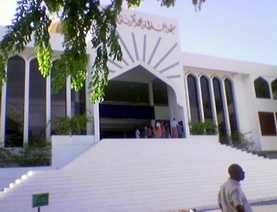
Sultan Mosque
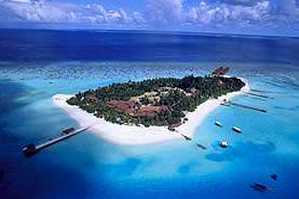
A typical resort, this one is the Laguna Beach Resort
Some people like the big game fishing and night fishing where you can usually go to an uninhabited island to have a barbecue after the fishing.
If you are interested in visiting the Maldives, Mr Muaz Adnan would be only too happy to advise you and make any travel arrangements and bookings for you. He can be contacted by e-mail on: muazadnan2002@yahoo.com
Google, the search engine can help you access satellite photos of North America’s most significant landmarks and locations, including the Grand Canyon, Alcatraz and Mount Rushmore. You need to enter in a zip code and a photo from space of that location – if available – is then shown. At the moment Google only offers satellite images of locations in the US and Canada but Keyhole Corporation, which Google bought last year has data for the whole globe so the service could be rolled out for other countries. The detail in some of the Google photos is impressive – putting zoom at the highest level lets you pick out individual houses and even cars. The catch? There’s a fee to use the service though a free 7 day trial is available. See: