I was looking forward to my first visit to Scandinavia. I had always wanted to visit Sweden but had been put off by the impression that it is really expensive and the desire to have better weather than at home when taking a break. Gothenburg is located on the south western coast of Sweden, at the mouth of the Gota River. As the plane descended toward Gothenburg City airport I had my first glimpse of Sweden. There was no sign of snow, but plenty of conifers and great views over the coastline. As I didn’t feel like rushing off the plane, I underwent a rather rapid acclimatisation as the end of the queue for passport control stretched outside in the icy blast. I donned the polo neck, hat and gloves before venturing out to find the bus into the city, There were a few people hanging around but no sign of a bus. I asked a young Swedish couple and they told the bus would not be there for over an hour. They asked if I wanted to share a taxi into the city with them. They were returning home from Carlisle, their place of study, for the holidays. Another young guy approached us, enquiring if he could share the taxi too, and he was a Swedish student from Edinburgh. The bus would have cost �4 but it was �6 for the shared taxi. I was glad to reach the city more quickly while it was still light.
My hotel, the Eggers, was just across from the railway station. It was originally built in 1859 as the railway hotel, yet although it was so central it was amazingly quiet. It was renovated in the 1990s, with the aim of maintaining its original charm. As soon as I stepped into the lobby I was in awe of the marble floor, the pair of Doric Greek Revival pillars and the chandeliers. My hotel room was understated elegance. It even had a small, tasteful chandelier. It was very comfortable, with appropriate antique furniture but also had a broadband internet connection!
I’d heard so much about Liseberg Park that I decided to visit on my first evening. Walking around the park made me feel more festive but in a typically understated Swedish way. It was really quite breath taking. 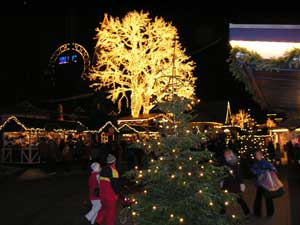 All the 3 million promised fairy lights were white and most of them draped around every branch of the trees, which made them look surreal. It was tasteful commercialism. The park was full of families, the kids excitedly queuing up for a ride in the reindeer drawn sleigh and toddlers practising their ski moves on the gentle nursery slope. There were braziers dotted around the park, in case you felt in need of quick heat or had some nuts to roast. The log cabin craft stalls sold all sorts of food, drink, gifts and homeware. It was very cold and windy, making me glad that I’d packed my thermal underwear.
I had heard the hotel had a haunted room, so next morning, I asked if I could see it. The manager very kindly showed me the room and told me the story. This was where the original owners of the hotel, the Eggers, had stayed. A couple of years ago when a chambermaid entered the room she saw an elderly lady sitting in one of the chairs in the lounge area. The chambermaid apologised to the lady saying that she had not realised that the room was occupied. The head housekeeper was consulted and confirmed that the room was vacant. On another occasion, a Swedish journalist staying in the room was advised by the barman to take a glass for the ghost when she retired to the room with a bottle one evening. She duly poured out a glassful for the ghost and when she awoke next morning the glass was empty!
I was keen to go down to the coast at Salthomen, a half hour tram ride from the city centre. I had a 48 hour Gothenburg Pass (costs around �24 for 48 hours) which covered all public transport, including ferries to the nearby islands and free entry to most museums and attractions. As Tuesday dawned (at around 9am) bright and sunny, I decided I should get going. Instead of being organised and first checking the times of the ferries to the nearby islands, I walked around and did some minor rock scrambling and took some photos. There were lots of boats tied up and wooden jetties to walk along. When I finally made it to the ferry terminal, I discovered that the ferry service had a 2 hour lunch break. There was a ferry just about to leave for the nearby island of Branno, but I either had to stay on the ferry and come straight back to Salthomen, or stay on the island for 2 hours and 20 minutes. I wasn’t willing to chance so long on the island as it was very cold, and I wasn’t sure what cafes or restaurants would have been open on a weekday in low season. I was cursing myself, as at any other time of the day I could have spent an hour on the island.
On arrival back at the city centre I decided to try a Swedish buffet lunch at the Scandic Europa Hotel. It was a wonderful spread, soup, salads, cold meats, breads, three hot main courses and a choice of desserts, for 98 Kroner (around �8). I have to say that I did not find Sweden to be any more expensive than the UK. I believe that alcohol is more expensive than in the UK, but as I never drink alcohol that didn’t affect me.
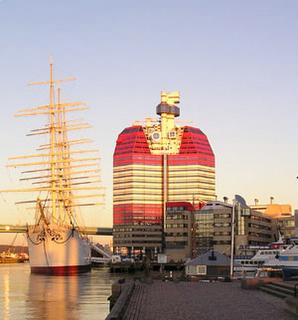 Then it was off the quayside to see the new Opera House and the sunset from the top of the Goteborgsutkiken (nicknamed the Lipstick). I also wanted to visit the Viking Barken, now used as a hotel-restaurant, and have a look at the cabins/rooms on board. There were 2 and 4 berth bunk bed cabins with shared bathroom facilities, or larger ensuite cabins. However, the lipstick viewpoint/cafe is only open during the summer. Anyway, I was keen to visit the City Museum, which closed at 5pm. The museum houses most of the wreck of a Viking longboat. There is a modern recreation of the boat hanging above, which gives you a more accurate idea of the dimensions. One of my favourite films as a child was a romantic adventure film about Vikings, starring Kirk Douglas. There were some Electrolux cylinder cleaners on display, and seeing things that you recall as household items as a child in a museum was rather disconcerting! There was a room featuring a Jubilee exhibition in Gothenburg during the Twenties. One of the reasons for the exhibition was to show Sweden’s industrial might. It also looked as though there was plenty of entertainment, and there was even a cr�che where you could leave the kids for the day.
The plan for that evening was to visit the Design Museum, as it was late closing there. It seemed to be sensible to do outdoor activities during daylight, and the museums in the evening. I returned to the hotel for a cup of tea (very thoughtfully provided in flasks in the foyer for guests). I already had a cold when I left Scotland and after being out in the cold I could not face going out again. I lay down on the bed at 5.15pm and then next thing I knew it was 7.30. The Design Museum was open until 9pm, but I had a bath, went back to bed and slept until 8am on Thursday morning. Although initially pretty annoyed with myself, I felt so much better the next morning, I consoled myself by rationalising that it was better to lose an evening than to chance feeling awful all the next day.
After breakfast I walked to the Fish Market. It’s called the “fish church”, as the building in which it’s housed resembles a church. It was much smaller than I anticipated. Then it was up to the Tradgards forenignen park to visit the palm house and the butterfly house. I had visions sitting reading with these tropical butterflies fluttering by. It was not to be, as it was closed for renovation. I wasn’t sure which museum to visit that afternoon, but was recommended to go the Universeum, 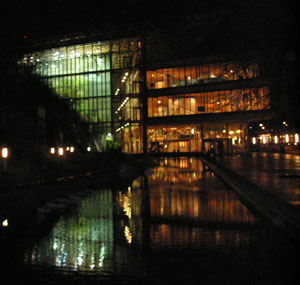 the science discovery centre. it was very imaginatively designed, with a recreated rainforest on several levels and a recreated Swedish landscape from mountain top to the seashore and below. There were also several floors of hands on activities. You could drive a Volvo lorry, design a model and get into nuclear physics (if so inclined). I couldn’t even manage to get 2 racing car models going with binary code! There are plenty of young enthusiastic multilingual guides at hand to explain things.
I did enjoy just walking around the city centre along the canal sides and through the narrow streets and the grand avenues. Gothenburg is a grand city in an architectural sense, very spacious. I’ve heard it called the Swedish Amsterdam. I think that this is a slight on Gothenburg, as in my opinion it is much more attractive and less commercialised than Amsterdam. As a lone female, I felt relatively safe walking around in the evening. There was very little litter around, no beggars or hustlers and a fairly obvious but discreet police presence. As soon as you approached a pedestrian crossing, the cars would stop. All the locals that I spoke to replied in good or excellent English and were very polite and helpful. I would call it an extremely civilised city, low key, sophisticated in an unpretentious manner, far from soulless and regimented yet orderly and relaxing.
Gothenburg can offer something for almost every taste and budget. Families are well catered for, most hotels have family rooms, there is the Liseberg amusement park and the Universeum (targeted at age 5 – 19). Kids under 17 can eat free at selected restaurants with the Gothenburg pass. The culture vultures have a plethora of museums and galleries to visit. The foodies can enjoy several Michelin starred restaurants and great choice of seafood. Nature lovers have the botanical gardens and the nearby coast and islands. Shopaholics have the largest covered shopping mall in Scandinavia. One of my sons tells me that there is a cool club scene there.
Gothenburg really does have it all. With the accessibility afforded by Ryanair flights (under 2 hours from Glasgow Prestwick) it is a great short break destination that does not, contrary to popular belief, break the bank. Many locals said to me that I should visit in the summer as it is lovely then. I enjoyed being there in the winter. It was dead quiet in the museums and the evening floodlighting was beautiful. There’s lots to do inside so your visit is not particularly affected by the weather. I was fortunate in my visit that it was dry all 4 days, although only sunny for one. Although the public transport is excellent, I did mainly walk around my ports of call in the city centre. It was too cold to stand waiting for buses and trams and I felt one sees more when walking around.
Karen Bryan is an independent travel consultant and writer, specialising in less well known destinations in Europe. Her websites are: www.europealacarte.co.uk

 Trip duration: 63 days


 We are sorry to say that Mac is not very well, but he is still e-mailing strong and recently sent the Beetle a collection of travel reminiscences.
 As for myself I like polyester clothes. They are comfortable to me but some look down on those that wear such. I am the world’s worst dresser. At 8l plus I dress for comfort and for survival. I wear a small backpack for medical stuff and survival stuff (granola candy bars etc) and always have too much in my pockets. People often ask me if I am going hiking. I say “No, just to the White House (joking) I recall some made fun of how Kruchev’s wife dressed when she was here. I thought that was impolite that time too. Ha! I do think it is unkind for the press and comedians to make fun of the way she dresses such as remarks she brought with her 57 frumpy dresses. I thought she was dressed appropriately besides she was nice to me. I told the British Ambassador and his wife about the Chelsea Pensioners (British equivalent to our Old Soldiers Home) visiting us and that I had visited them many, many years ago on my own. Everyone was very nice. Lets all be nice to each other!
 After the wreath ceremony at WW2 memorial, I looked at the wreath they laid. It had something about thanking WW2 veterans and was simply signed Charlie and Camilla. Or maybe it was Charles and Camilla. No title given and since the wreath was small it occurred to me that later visitors might wonder who this Charles and Camilla were. Ha! Who was this couple that spent their good money to honour WWII veterans??